
Why a Bunion Is Not "Just a Bump"
A common misconception is that a bunion is an overgrowth of bone on the side of the foot that a surgeon simply "shaves off." In reality, a bunion (hallux valgus) is a structural, three-dimensional deformity: the long first metatarsal bone drifts outward toward the inner border of your foot, while the big toe leans inward toward the second toe. Simply shaving the bump without realigning the bone leaves the mechanical deformity intact and carries a high rate of recurrence.
True, lasting bunion correction requires cutting and shifting the bone back into straight alignment. The difference between The Jiffy Bunion™ and traditional open bunion surgery lies in how that bony correction is achieved—and how gently the surrounding tissues are treated.
How The Jiffy Bunion™ Realigns the Bone in 3 Steps
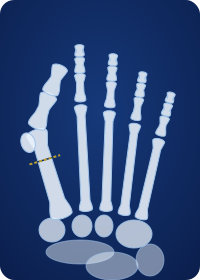 1. Precise Cut
Through a 1 mm incision under live X-ray
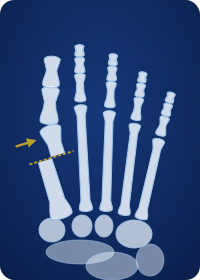 2. 3D Shift
Bone glided into straight anatomical line
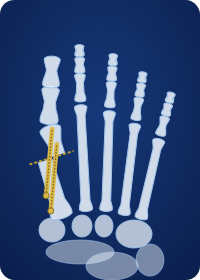 3. Flush Fixation
Two headless screws lock the bone securely
- 1 mm Incisions (No Long Open Incision): Instead of making a 2-to-4-inch incision along the foot and stripping the periosteum and joint capsule, Dr. Moore works through tiny 1 mm incisions along the medial border of the foot using a specialized, cooled micro-burr under real-time fluoroscopic X-ray guidance.
- Three-Dimensional Translation & Realignment: Because the osteotomy is performed percutaneously, the head of the first metatarsal can be shifted substantially laterally, plantarly, and rotationally to narrow the forefoot and restore natural joint congruency.
- Rigid Fixation With Two Flush Headless Beveled Screws: Once the bone is aligned, two specialized titanium headless beveled screws are placed across the bone corridor. Because the screw heads are beveled flush with the bone cortex, there are no bulky plates sitting under thin skin—and stability is strong enough for immediate weight-bearing in a post-op shoe.
In many patients, Dr. Moore also makes a tiny percutaneous cut in the base of the big toe bone (proximal phalanx) to fine-tune the toe's straight profile. If a longstanding bunion has crowded your second toe into a hammertoe or crossover toe, those lesser-toe corrections can be performed during the exact same outpatient surgery.
Side-by-Side: The Jiffy Bunion™ vs. Traditional Open Surgery
| Comparison Factor | The Jiffy Bunion™ (MIS) | Traditional Open Bunionectomy |
|---|---|---|
| Incisions | A few 1 mm incisions closed with single stitches. | 2 to 4+ inch open incision over the joint and shaft. |
| Soft-Tissue Preservation | Minimal soft-tissue disruption; preserves blood supply and joint mobility. | Wide capsular exposure and soft-tissue stripping, increasing scar tissue and stiffness risk. |
| Internal Hardware | Two headless beveled screws seated flush inside the bone. | Often utilizes surface plates and multiple cortical screws that can feel prominent under the skin. |
| Immediate Walking | Walk on Surgery Day (Day 0) in a protective post-op shoe. | Frequently requires weeks of non-weight-bearing with crutches, a cast, or a knee scooter. |
| Regular Footwear | Average of ~6 weeks into supportive athletic shoes. | Often 10 to 16+ weeks before comfortable shoe transition. |
Why Surgeon Experience Matters in Minimally Invasive Bunion Surgery
Minimally invasive bunion surgery relies on tactile precision and three-dimensional fluoroscopic navigation rather than wide visual exposure. Blake E. Moore, MD, FAAOS is a fellowship-trained orthopaedic foot and ankle surgeon, national course faculty instructor on precision forefoot correction, and 7-time consecutive Coastal Virginia Magazine "Top Doc" (2020–2026).